
Abell 2256 – 800 million light-years distant.
Via phys.org:
“The image reveals details of the interactions between the two merging clusters and suggests that previously unexpected physical processes are at work in such encounters.”
Abell 2256 – 800 million light-years distant.
“The image reveals details of the interactions between the two merging clusters and suggests that previously unexpected physical processes are at work in such encounters.”
What follows are a jumble of interesting things I’ve found out about recently:

New diffusion MRI technology provides unprecedented detail of the connections in the brain. The fibers are color-coded by direction: red = left-right, green = anterior-posterior, blue = ascending-descending. Source: The Human Connectome Project
Leo Sternbach – chemist who was the discoverer of benzodiazepines, including well known drugs such as Valium, Librium, and Klonopin. It’s funny that although he’s credited as a discoverer instead of inventor, these drugs are nonetheless patented and marketed commercial products.
Typhoid Mary – I always wondered who this was. Her name is better known than her story. This poor woman carried the disease but was immune, and unwittingly infected at least 51 people with Typhoid Fever. She was treated like a criminal and quarantened for life, a victim of science’s inability at the time to effectively treat contagious diseases. Today, “Typhoid Mary” is a colloquial term for anyone who, knowingly or not, spreads something undesirable.
From The Story of the Human Body: Evolution, Health, and Disease
The Guy Fawkes mask has a long history of being a symbol of popular dissent and protest. Ironically, the most familiar version is owned by Time Warner and is paid a licensing fee for every mask sold. You just can’t win.
The Radiolab Podcast, of particular interest are the episodes ‘Numbers‘ and ‘La Mancha Screw Job‘
Cui bono – when trying to make sense of a situation, ask “to whose benefit?”

This book explores the shortcomings in medicine when it comes to preparing patients for death. Is the goal to extend life as far out as possible or to make sure that a person’s last days as well spent as possible? In Dr. Gawande’s view, doctors are more like mechanics charged with fixing problems in a deteriorating old car rather than caretakers whose job is to help maintain a patient’s dignity and quality of life until their last day. He sees this as misguided and this book is a plea to his profession to do better.
Dr. Gawande interviews hospice care professionals and other doctors, and examines different treatment options for people entering old age or diagnosed with a terminal illness. He also weaves patient’s stories and his own experience into the narrative, such as is own father’s decline and his experiences delivering devastating news of terminal illness to patients. Being Mortal is a thoughtful examination of what is important in life and how to make the final days of those near death as full of life as possible.
Further Links:
Frontline: Being Mortal—PBS television companion to the book.
‘Letting Go: What should medicine do when it can’t save your life?’ Dr. Gawande’s New Yorker essay that inspired the book.
What the professionals had to say: The Guardian review.
Buy on Amazon: Being Mortal: Medicine and What Matters in the End
Stuff of Interest:
tachycardic—a heart rate higher than normal, typically 100 bpm or more.
cutaneous mechanoreceptors—nerves and sensory receptors
skein—a tangled or complicated arrangement, state, or situation.
Lewis Thomas, physician-writer— quoted as being skeptical of the efficacy of hospital care in 1937: “If being in a hospital bed made a difference, it was mostly the difference produced by warmth, shelter, and food, and attentive, friendly care, and the matchless skill of the nurses in providing these things. Whether you survived or not depended on the natural history of the disease itself. Medicine made little or no difference.”
Hill Burton Act, 1946—Federal law that provided massive government funding for hospital construction. Within twenty years, over 9,000 medical facilities were built across the country.
Park Place—The first assisted living facility, opened in Portland in 1983 by Karen Brown Wilson.
Eden Alternative—a senior living alternative that has lots of pets, greenery, and few residents that receive personalized care. Designed to pursue the idea that a life worth living can be created, in this case, by focusing on food, homemaking, and community.
‘The Median Isn’t the Message‘, by Stephen J. Gould—Essay by the renowned scientist that Dr. Gawunde appreciates, but disagrees with its blind optimism.
Nelene Fox—woman who died from breast cancer but whose estate won an $89 million settlement posthumously from her insurance company for withholding coverage for experimental treatment that was later deemed ineffective.
‘Four Models of the Physician-Patient Relationship‘, by Ezekiel J. Emanuel and Linda L. Emanuel—a scholarly article describing the power dynamic between physicians and patients. Summarized here.
Google keeps an archive of their daily homepage doodles. Enjoy!


Whenever someone tells me they hate their job or they’re unemployed, I ask for their smartphone and download an app for them called Feedly. I tell them how it works and they nod their head and then don’t use it. You can lead a horse to water but you can’t make it get a job.
Feedly is an RSS feed, which is basically TiVo for the internet. It eliminates advertising and gathers all updates on your favorite websites into one place. This has many applications, from entertainment to headline news gathering, but for the purpose of this post I’m going to show how to use it to job hunt more effectively.
When you link job search sites to your Feedly account you get updates in real-time about job postings in your city. You can link Craigslist but I prefer Indeed because there are fewer rapists.
Feedly can be used to search for your dream job in a career of your choice or if you simply need something to pay the bills you can easily get something going quickly. It connects desperate employees with desperate employers.
Say you have a background in Restaurant Management:
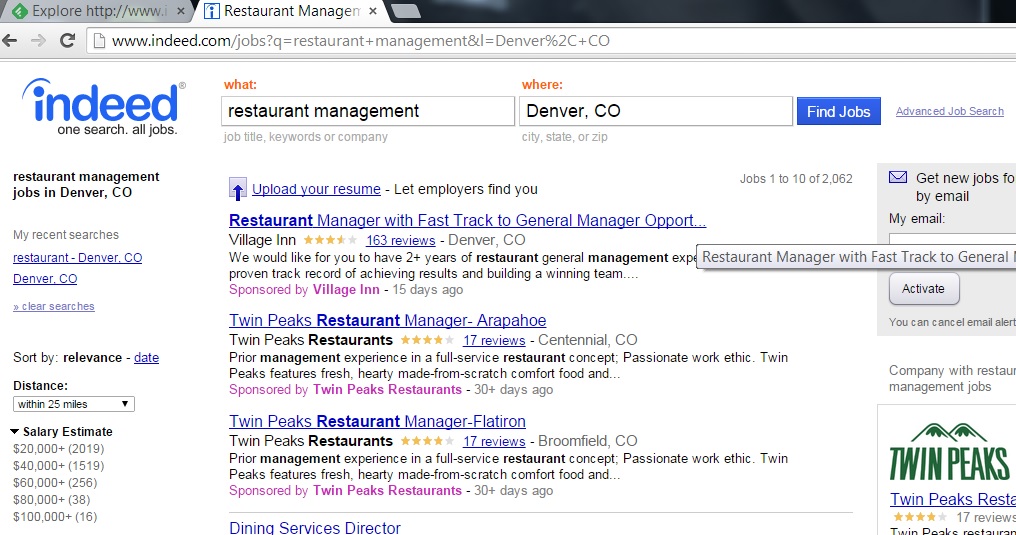
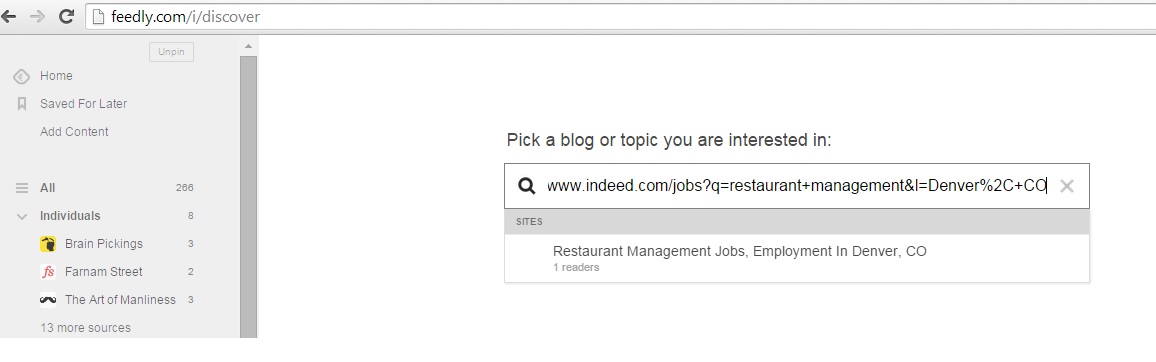

Viola! You’ll be managing a Twin Peaks in no time.
The advantage this provides is getting notified of new openings IMMEDIATELY. That way, you can be quicker than anyone else submitting your resume into the digital pile that gets ignored by hiring managers everywhere.
One last tip: Indeed has a ‘quick apply’ feature where you upload your resume and you can apply to certain jobs almost instantly. This eliminates the hassle of writing a stupid cover letter.
What are you waiting for? Get a job, you filthy animal!

Salvador Dalí, Tête Raphaëlesque éclatée [Exploding Raphaelesque Head], 1951
Take the e-tour at the National Gallery of Scotland’s website where the work resides and listen to Scottish people talk about the finer details:
“People think they don’t understand math, but it’s all about how you explain it to them. If you ask a drunkard what number is larger, 2/3 or 3/5, he won’t be able to tell you. But if you rephrase the question: what is better, 2 bottles of vodka for 3 people or 3 bottles of vodka for 5 people, he will tell you right away: 2 bottles for 3 people, of course.”
-Israel Gelfand
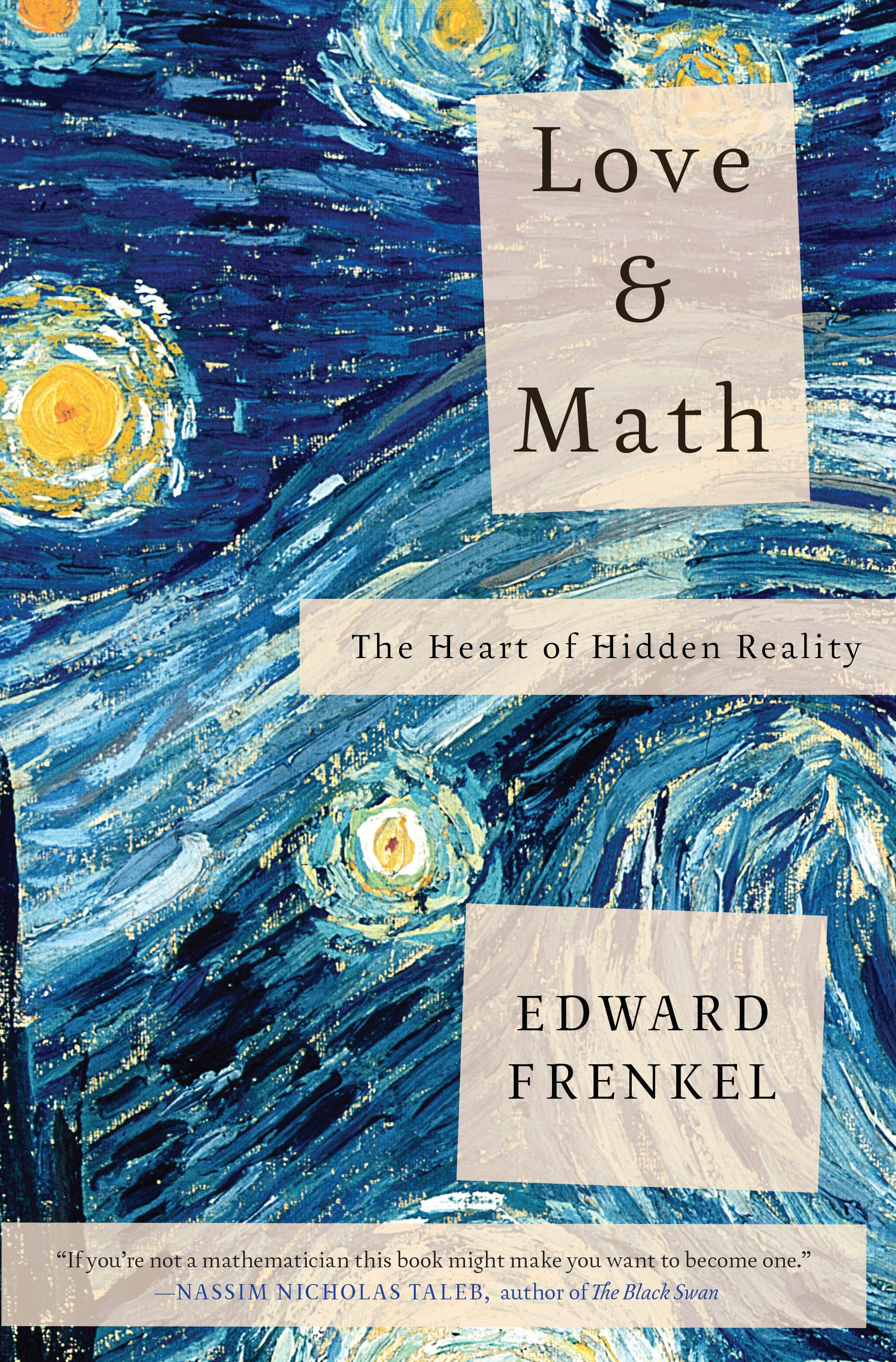
Edward Frenkel does a good job highlighting the pivotal importance of math. He asserts that instead of being a dull academic subject, it’s a universal language, free from bias, that can make apparent the deeper mysteries of the universe. If only it was taught different in schools.
Frenkel is a professor of mathematics at UC Berkeley. Even though he is under fifty, he has had a rich and distinguished career that traces back to the Soviet Union of the 1980’s, when Communist oppression was in full force. His story is my favorite part of this book, and his struggle just to get a decent education as a Jew facing blatant bureaucratic discrimination made me more appreciative of the freedoms I enjoy. indeed, this oppression was a source of strength for him, going on to say that, “In this environment, mathematics and theoretical physics were oases of freedom. Through communist apparatchiks wanted to control every aspect of life, these areas were just too abstract and difficult for them to understand.” Mathematics set him free, and his passion for the subject is infectious because he’s also a clear and thoughtful writer.
Further Links:
Slate piece by the author, illuminating the political importance of a mathematically literate society.
Farnam Street review, more in depth than my own.
What the professionals had to say: The New York Times review.
Buy from Amazon: Love and Math: The Heart of Hidden Reality

I find that there are few things more life affirming than walking through a cemetery on a gorgeous day. As your eyes pass over each headstone, names and dates tumble through your mind, drawing associations and thinking of questions for the dead.
Walking through the Olinger Crown Hill Cemetery on a clear spring day, I saw the tombstone Ulysses S. Grant who was born in the mid-1870s and died in 1919. You wonder how he felt being named after a war hero and president. Did he feel dignified? Was it annoying? Did he feel like Michael Bolton in Office Space?
Further back, walking off the trail, there’s an area for infants born a hundred years ago. Here lies James D. Norton, alive for three months in 1916. And others. Unsure whether to feel lucky to have survived infancy or slump my shoulders in grief, I took time to do both.
Off in the far corner, the military men are divided by wars they served in. Among the older graves stands a monument to the Spanish American War. What was that war even about? Did it even matter?
More importantly: was it worth it?
Moving on, I saw the tombstone of a 26-year old World War II veteran. He survived the war but not the 1950’s. You think about all the sagely WWII veterans who lived to old age and how admirable they all were. Why didn’t this one make it?
Among the we are forced to answer the question Leo Tolstoy (1828-1910) felt was central to life itself:
“My question, the one which brought me, at the age of fifty, to the verge of suicide, was the simplest of questions, the one that every man carries in the depths of himself, from the stupidest child to the wisest old man–the question without answering which life is impossible, as I indeed experienced. Here is that question: ‘What will come of what I do now, of what I will do tomorrow–what will come of my whole life?’ Formulated differently, the question would be the following: ‘Why should I live, why desire anything, why do anything?’ It can also be put like this: ‘Is there a meaning in my life that will not be annihilated by the death that inevitably awaits me?’“
We are built to confront this question, whether or not we are prepared to answer it. Any other secular place around town lacks the gravitas to pose these weighty questions to us. A higher meaning might be advertised in a department store but good luck actually finding it.

The point of this book is tough to describe. The author is so persuasive that he could probably convince me of anything, his examples are so wide ranging and his conclusions far fetched but airtight. One way Robert Wright states his hypothesis is that Francis Crick is wrongly credited with discovering the secret to life in DNA. John von Neumannn is a better candidate for that distinction with his discovery of game theory.
He posits that overall, human history has been trending toward greater cooperation and connectivity. As ideas and industry spread, more people become dependent on one another and their tribal circle expands, allowing even greater cooperation. This all sounds very utopian and rosy, and this book was written pre-9/11, but the more Wright expands his argument, the more you realize he isn’t crazy or stupid. If nothing else, this book is an incredibly persuasive example of revisionist history. I don’t mean that because it’s false, but it does make you rethink what you thought you knew. My favorite digression is the part about barbarians, “we were all once barbarians”.
Further Links:
Robert Wright’s TED Talk on non-zero-sumness: He’s certainly a better writer than public speaker.
The Nerdist Podcast with Jon Favreau: Good throughout, at around 1:06 Favreau has a thought that elucidates the theme of this book very well. I wonder if he’s read it.
This book is on Bill Clinton’s list of favorite books. Lists of imminent people’s favorite books are always interesting, here’s Teddy Roosevelt’s.
Buy on Amazon: Nonzero: The Logic of Human Destiny
Stuff of Interest:
teleological—an attempt to describe why something happened, instead of simply noting its existence.
Lewis Henry Morgan, John Stuart Mill, and Margaret Mead: notable people with differing views of the directionality of history (does it follow a path or not?).
Hobson’s Choice— ‘Take it of leave it’ a choice in which only one option is offered.
Jericho—The history of this city is incredible. I thought it was a Biblical myth but is in fact real as Cincinnati (another place I’ve never been).
Continue reading

“Man naturally desires not only to be loved, but to be lovely.”
—Adam Smith
Russ Roberts is an academic economist best known as the host of the EconTalk podcast, wherein he interviews people knowledgeable in public policy and economics. This book is his exploration of what Adam Smith had to say about living a good life. Roberts thinks it’s a shame that Smith is thought of as an economist before a moral philosopher, and seeks to remind readers through this book of the power of Smith’s moral wisdom. He focuses primarily on Smith’s book The Theory of Moral Sentiments rather than the work Smith is best known for, The Wealth of Nations, which unfortunately is commonly used to legitimize the power of venal self-interest.
How Adam Smith Could Change Your Life explores the idea of acting like you have someone, some ‘indifferent spectator’, judging your actions. Something like a conscience. The importance of introspection is also examined, along with some reasons why self-knowledge is so difficult, the corrosive pitfalls of seeking out fame, how empathy with someone is easier in good times than in bad, and how tempting but dangerous it is to make exceptions in some circumstances. “Smith admits there can be some extenuating circumstances that make the rules of justice more flexible. But he suggests that such an approach to justice is a very slippery slope. He urges us to follow the rules of justice with complete steadfastness; the more we do so, the more commendable and dependable we are.
I also enjoyed P.J. O’Rourke’s On The Wealth of Nations: Books That Changed the World
Further Links:
School of Life’s video profile on Adam Smith, along with his write-up in The Philosopher’s Mail.
Part 1 of a 6 part series of interviews with Dan Klein that inspired the book.
What the professionals had to say: The Wall Street Journal book review.
Buy from Amazon: How Adam Smith Can Change Your Life: An Unexpected Guide to Human Nature and Happiness


