I have the privilege of living only a few miles from Sloan’s Lake. When the whether is nice, I enjoy the two mile walk.

Nicer than it looks.
I have the privilege of living only a few miles from Sloan’s Lake. When the whether is nice, I enjoy the two mile walk.
Nicer than it looks.

The Great Salt Lake, Utah
This month, I got more adventurous in the kitchen. I cooked Grain-free banana pancakes, lasagna, and chicken fajitas, while my brother cooked turkey meat loaf (all delicious!) from The Paleo Cookbook: 300 Delicious Paleo Diet Recipes.
I learned a little about North American geology, human health and evolution, and what it means to live a happy life (hint: what you spend your time concentrating on is of paramount importance).
I took an exhausting but glorious hike up the Manitou Springs incline.
The most interesting article I read online was called ‘In Search of Japanese Roots‘ about the confusion of native Japanese heritage, and their ongoing enmity with the Koreans. Japan is so isolated, being about 100 miles from mainland China, but among other curiosities are that it has the first recorded instance of man-made pottery—made especially strange by the intuitive bias that ancient innovations began on mainland territories then filtered out to islands. Also of interest in this article are the Korean nose tombs (it is what it sounds like) and the unclear origins of the Ainu. For more information, check out the Association for Asian Research.
From Netflix
(I watched entirely too much TV. No regrets.)
The third season of House of Cards was thrilling as usual. I’ll keep mum on the spoilers and leave it at that. Black Mirror blew my mind, especially ‘The Entire History of You‘, which Wikipedia says Robert Downey Jr. has optioned to make a film of. If he can do better, good luck, but he’s probably just high again.
American Experience: JFK revealed the 35th president to me in ways I’d never before known him. I had heard about Kennedy’s shameless philandering but didn’t know about his serious health problems. This guy was on a crippling amount of narcotics throughout his presidency. I didn’t realize how underdeveloped his presidency was. He made a ton of mistakes. He made a lot of fumbles with diplomatic relations with Cuba and Soviet Russia. He set the Vietnam War down the ruinous path it ultimately took. He trusted brains over experience. But he prevented the outbreak of nuclear war, which was scary close to happening. And if several of his advisers had had their way, the Cuban Missile Crisis would’ve gone much differently. In school, I learned that his cabinet was a textbook example of groupthink. It certainly was, but if it had been mindless and without conscious a nuclear bomb certainly would’ve gone off.
Vietnam in HD showed me combats footage and interviews with the men who served in the Vietnam War. This documentary isn’t very good, it’s full of clumsy celebrity narration that was only put in there for the sake of attaching famous people to the project. But it does have some insane war footage, and I cringe to think that my own father could’ve been sent there. I didn’t realize that for a time the draft didn’t exempt college students. If anything, this documentary is important only because it shows how fallible those in power are and that something equally terrible can still happen.
Prohibition by Ken Burns held similar lessons. That even when your intentions are pure, the outcome of your actions are entirely unpredictable and can even lead to moral catastrophe. Even at a superficial level, the parallels between the problems of prohibition and the War on Drugs have been uncanny. I’d known that prohibition had happened but only peripherally—I didn’t appreciate that it was an amendment to the Constitution! The law itself lasted 13 years, 10 months, and 18 days. As one confident teetotaler said, “There’s as much chance of repealing the 18th Amendment as there is for a humming bird to fly to Mars with the Washington Monument tied to its tail.”
Among other things, I found out about Carrie Nation, the bitter old woman who went around trashing saloons; that during World War I sauerkraut was rechristened liberty cabbage as part of the anti-German propaganda campaign, the rise and tragic fall of George Remus, and more.

Commitment to a goal and to the rules it entails is much easier when the choices are few and clear.
This book examines the ways in which people derive meaning from their lives. Mihaly Csikszentmihalyi’s conclusion is delightfully ambiguous: that it doesn’t matter what we do that makes a particular activity fulfilling, but rather how we do it. He calls this state of concentration flow–the sweet spot between anxiety and competence wherein a person confronts a challenge that tests the limits of their abilities. A similar intensity of focus can be seen among the most successful practitioners of a whole range of disciplines, from poets and scientists to rock climbers and surgeons.
In Mihaly’s estimation, A flow experience requires nine components in order to be rewarding: 1.) There are clear goals every step of the way. 2.) There is immediate feedback to one’s actions; 3.) There is a balance between challenges and skills; 4.) Action and awareness are merged; 5.) Distractions are excluded from consciousness; 6.) There is no worry of failure; 7.) Self-consciousness disappears; 8.) The sense of time becomes distorted; and 9.) The activity becomes autotelic (Done for the joy of the experience they provide rather than for the final outcome.)
Mihaly Csikszentmihalyi has over 50 years experience as a professor and research psychologist. His writing is both well in formed and thoughtful–his insights flow breezily off the page and his wisdom is easily apparent. For example, here’s an extraordinarily insightful quote from him on his Wikipedia page: “Repression is not the way to virtue. When people restrain themselves out of fear, their lives are by necessity diminished. Only through freely chosen discipline can life be enjoyed and still kept within the bounds of reason.”
Further Links:
A good video introduction to the author and his life work.
The author’s TED talk on flow.
What the professionals are saying: The LA Times Review
Quotes and Anecdotes: The Autotelic Personality, The Effects of Family on the Autotelic Personality, How to Keep Love Fresh, The Difficulties of Solitude, and Wasting Time.
Buy on Amazon: Flow: The Psychology of Optimal Experience (Harper Perennial Modern Classics)
Stuff of Interest:
flow–“the state in which people are so involved in an activity that nothing else seems to matter; the experience itself is so enjoyable that people will do it even at great cost, for the sheer sake of doing it.”
optimal experience–“Contrary to what we usually believe, moments like these, the best moments in our lives are not the passive, receptive, relaxing times—although such experiences can also be enjoyable, if we have worked hard to attain them. The best moments usually occur when a person’s body or mind is stretched to its limits in a voluntary effort to accomplish something difficult and worthwhile. Optimal experience is thus something that we make happen.”
Phenomenology–the study of structures of consciousness as experienced from the first-person point of view. The central structure of an experience is its intentionality, its being directed toward something, as it is an experience of or about some object.
epiphenomen—is a secondary phenomenon that occurs alongside or in parallel to a primary phenomenon. Closely related to ’cause and effect’.
dialectal–relating to the logical discussion of ideas and opinions.
invidious–likely to arouse or incur resentment or anger in others.
anomie–lack of the usual social or ethical standards in an individual or group.
Diogenes looking for an honest man with his lamp
Ignatius of Loyola
Ignaz Semmelweiz
Necker cube
Kubla Kahn, Samuel Coleridge
Antonio Gramsci
Altius, citius, fortius (higher, faster, stronger)
“Eternal vigilance is the price of liberty” –Thomas Jefferson

“The future is already here — it’s just not very evenly distributed.” — William Gibson
Uber gets all the publicity, but this is a less publicized case of the old guard trying to shutter innovation. Six years after this article from Wired was published, I’m starting to see them frequently in public restrooms. The Sprout’s near my house even has a self-congratulatory plaque in their men’s room that says how much water they’re saving, roughly 20,000 gallons annually per urinal. If that’s even ballpark accurate, that’s insane!
The push back from the plumbers union reminds me of a quotation I lifted from an issue of The Economist some time ago:
“Too many people do well out of today’s system to make change easy.”

Paul Cézanne, The Large Bathers, 1906
This painting by Paul Cézanne was brought to my attention by the book I’m currently reading, the delightful Flow: The Psychology of Optimal Experience
“Occasionally people stop to ‘feast their eyes’ when a particularly gorgeous sight happens to appear in front of them, but they do not cultivate systematically the potential of their vision. Visual skills, however, can provide constant access to enjoyable experiences. Meander, the classical poet well expressed the pleasure we can derive from just watching nature: “The sun that lights us all, the stars, the sea, the train of clouds, the spark of fire—if you live a hundred years or only a few, you can never see anything higher than them.” The visual arts are some of the best training grounds for developing these skills. Here are some descriptions by people versed in the arts about the sensation of really being able to see. The first recalls an almost Zen-like encounter with a favorite painting, and empathizes the sudden epiphany of order that seems to arise from seeing a work that embodies visual harmony: ‘There is that wonderful Cézanne ‘Bathers’ in the Philadelphia Museum…which…gives you in one glance that great sense of a scheme, not necessarily rational, but that things come together…[That] is the way in which the work of art allows you to have a sudden appreciation of, an understanding of the world. That may mean your place in it, that may mean what bathers on the side of a river on a summer day are all about…that may mean the ability to suddenly let go of ourselves and understand our connection to the world…'”
And here is commentary from Kahn Academy:
“‘What comes to you after looking at it calmly, after you’ve really digested every nuance and every little thread, is the total impact. When you encounter a very great work of art, you just know it and it thrills you in all your senses, not just visually, but sensually and intellectually.'”
It’s unfortunate that no matter how high quality the resolution, no digital representation could match standing in front of the real thing. We’re very lucky that just about every major metropolitan area has an art museum open to the public. For instance, Dallas has a free one that is very nice. Take some time out to go to an art museum near you.
Yesterday, I had the pleasure of hiking the Manitou Springs Incline just outside of Colorado Springs.

How do you climb a mountain? One step at a time.
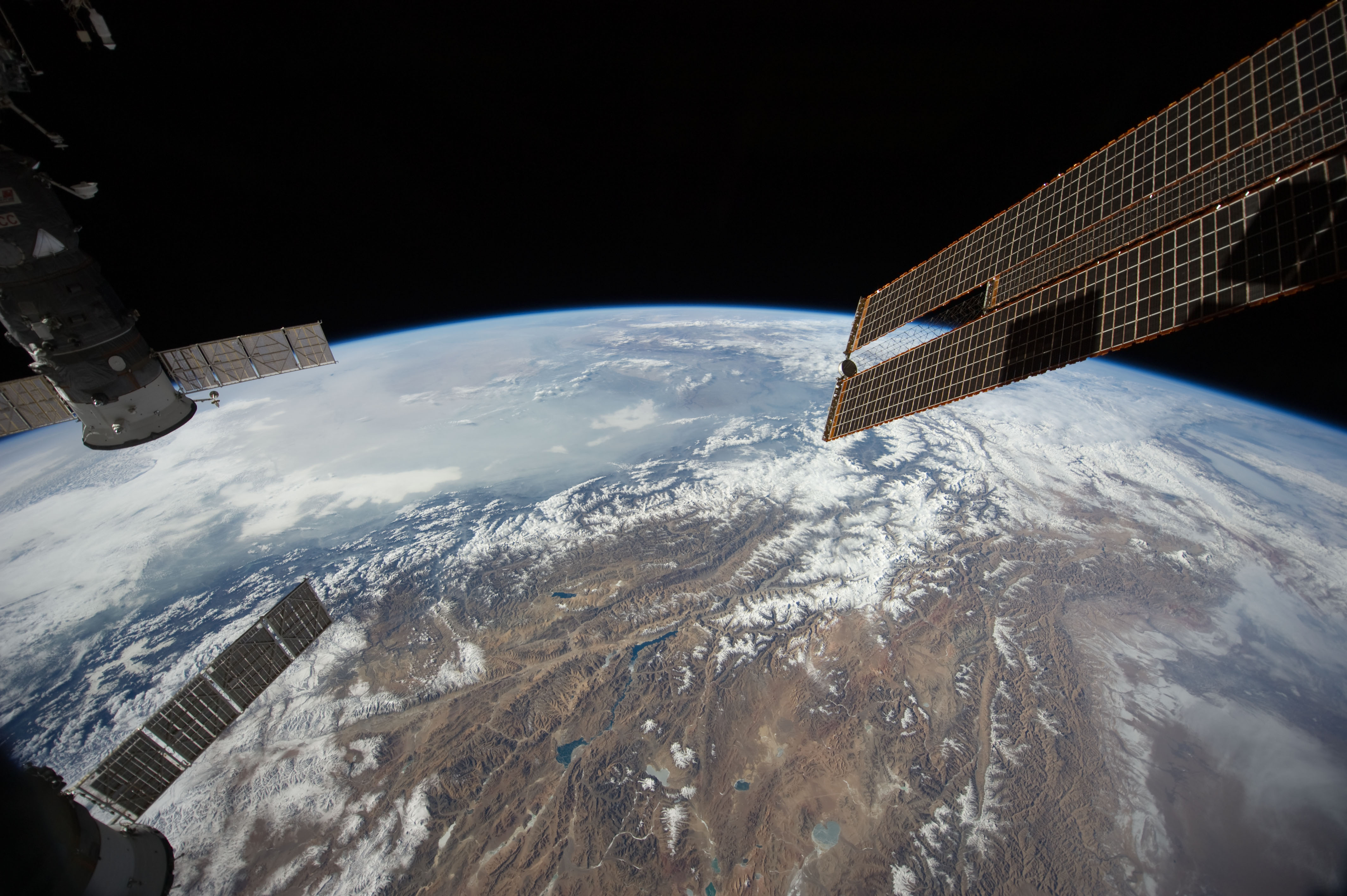
One man’s perspective on the ecological and historical significance of the Tibetan landscape, as seen from space. Also of interest is the the source of this article’s photography, the Gateway to Astronaut Photography of Earth, even though its database is so vast it’s tough to navigate.

This book looks at human evolution with a special emphasis on the ways our bodies aren’t adapted to the modern world. It defines dysevolution as the mismatch of present day culture and circumstances interacting with the human body in a harmful way. Cultural evolution happens at an exponentially faster pace compared to biological evolution and so our bodies haven’t caught up to modern living or diets. Because of this, many of today’s most common ailments are caused by the way we live. Cancer, diabetes, heart disease, myopia, and tooth decay are all discussed, among others.
Further Links:
Ozzy TEDMED: The Prince of Darkness’ genome is examined.
What the professionals had to say: The Washington Post review.
Buy on Amazon: The Story of the Human Body: Evolution, Health, and Disease
Stuff of Interest:
Pangloss— The professor in Candide, who is an eternal optimist.
mellifluous—sweet or musical; pleasant to hear.
nascent— just coming into existence and beginning to display signs of future potential.
yaws—the nonvenereal precursor of syphilis, still common in tropical countries.
Sahelanthropus tchadensis—6 to 7 million year old ancestor of humanity.
australopith—4 million year old ancestor of humanity.
phenotypic plasticity—the capacity for bodies to adjust their observable characteristics (their phenotype) in response to environmental stresses. (Example: children who exercise more from an early age develop thicker bones, just as children raised in hot climates develop more sweat glands).
These four years of data represent the fastest expansion of oil production in U.S. history. New technology drove this boom—particularly the deployment of horizontal drilling through shale rock. The three biggest oil-producing shale regions are the Permian basin in West Texas, the Eagle Ford in Southern Texas, and the Bakken in North Dakota. Hover on the map for drilling history in each basin.As the price of oil plunged in the second half of last year, producers started shutting down rigs at an unprecedented rate. First to go were rigs that operated without long-term contracts. Then companies began terminating agreements early and letting expired contracts go unrenewed. Active rigs declined by more than 40 percent. Remaining drilling efforts have focused on the most productive oil regions—sweet spots where oil will be profitable even at $40 a barrel.

Not quite the lottery.
Whenever you don’t pickup a paycheck, utility bill refund or rental deposit, it doesn’t get thrown away. Instead, it’s turned over to the unclaimed property fund in your your state and waits silently for you to claim it. For some reason this is poorly advertised, but each state has a searchable online database of these records (SEE: below). If you find that your state has money for you, all you have to do is fill out a form and they’ll send you your money, free, no questions asked.
The accumulation of these individual debts is mind boggling. I couldn’t find a national total, but New York state’s site claims to be holding over $13 billion in unclaimed funds, Idaho claims to have $120 million. Celebrities also have a ton of money tied up in this system (In Maine, Stephen King has ‘over $100’ in unclaimed wages from Walt Disney, Arnold Schwarzenegger has .15¢ in unclaimed funds with California.)
What are you waiting for? Search your kids, search your wife, search your cousins, co-workers, friends, acquaintances, everyone you know. Go to this Federal government website or search my homegrown list of State Unclaimed Property Databases here:


