Yesterday, I had the pleasure of hiking the Manitou Springs Incline just outside of Colorado Springs.

How do you climb a mountain? One step at a time.
Yesterday, I had the pleasure of hiking the Manitou Springs Incline just outside of Colorado Springs.
How do you climb a mountain? One step at a time.

One man’s perspective on the ecological and historical significance of the Tibetan landscape, as seen from space. Also of interest is the the source of this article’s photography, the Gateway to Astronaut Photography of Earth, even though its database is so vast it’s tough to navigate.

This book looks at human evolution with a special emphasis on the ways our bodies aren’t adapted to the modern world. It defines dysevolution as the mismatch of present day culture and circumstances interacting with the human body in a harmful way. Cultural evolution happens at an exponentially faster pace compared to biological evolution and so our bodies haven’t caught up to modern living or diets. Because of this, many of today’s most common ailments are caused by the way we live. Cancer, diabetes, heart disease, myopia, and tooth decay are all discussed, among others.
Further Links:
Ozzy TEDMED: The Prince of Darkness’ genome is examined.
What the professionals had to say: The Washington Post review.
Buy on Amazon: The Story of the Human Body: Evolution, Health, and Disease
Stuff of Interest:
Pangloss— The professor in Candide, who is an eternal optimist.
mellifluous—sweet or musical; pleasant to hear.
nascent— just coming into existence and beginning to display signs of future potential.
yaws—the nonvenereal precursor of syphilis, still common in tropical countries.
Sahelanthropus tchadensis—6 to 7 million year old ancestor of humanity.
australopith—4 million year old ancestor of humanity.
phenotypic plasticity—the capacity for bodies to adjust their observable characteristics (their phenotype) in response to environmental stresses. (Example: children who exercise more from an early age develop thicker bones, just as children raised in hot climates develop more sweat glands).
These four years of data represent the fastest expansion of oil production in U.S. history. New technology drove this boom—particularly the deployment of horizontal drilling through shale rock. The three biggest oil-producing shale regions are the Permian basin in West Texas, the Eagle Ford in Southern Texas, and the Bakken in North Dakota. Hover on the map for drilling history in each basin.As the price of oil plunged in the second half of last year, producers started shutting down rigs at an unprecedented rate. First to go were rigs that operated without long-term contracts. Then companies began terminating agreements early and letting expired contracts go unrenewed. Active rigs declined by more than 40 percent. Remaining drilling efforts have focused on the most productive oil regions—sweet spots where oil will be profitable even at $40 a barrel.

Not quite the lottery.
Whenever you don’t pickup a paycheck, utility bill refund or rental deposit, it doesn’t get thrown away. Instead, it’s turned over to the unclaimed property fund in your your state and waits silently for you to claim it. For some reason this is poorly advertised, but each state has a searchable online database of these records (SEE: below). If you find that your state has money for you, all you have to do is fill out a form and they’ll send you your money, free, no questions asked.
The accumulation of these individual debts is mind boggling. I couldn’t find a national total, but New York state’s site claims to be holding over $13 billion in unclaimed funds, Idaho claims to have $120 million. Celebrities also have a ton of money tied up in this system (In Maine, Stephen King has ‘over $100’ in unclaimed wages from Walt Disney, Arnold Schwarzenegger has .15¢ in unclaimed funds with California.)
What are you waiting for? Search your kids, search your wife, search your cousins, co-workers, friends, acquaintances, everyone you know. Go to this Federal government website or search my homegrown list of State Unclaimed Property Databases here:

Abell 2256 – 800 million light-years distant.
“The image reveals details of the interactions between the two merging clusters and suggests that previously unexpected physical processes are at work in such encounters.”
What follows are a jumble of interesting things I’ve found out about recently:

New diffusion MRI technology provides unprecedented detail of the connections in the brain. The fibers are color-coded by direction: red = left-right, green = anterior-posterior, blue = ascending-descending. Source: The Human Connectome Project
Leo Sternbach – chemist who was the discoverer of benzodiazepines, including well known drugs such as Valium, Librium, and Klonopin. It’s funny that although he’s credited as a discoverer instead of inventor, these drugs are nonetheless patented and marketed commercial products.
Typhoid Mary – I always wondered who this was. Her name is better known than her story. This poor woman carried the disease but was immune, and unwittingly infected at least 51 people with Typhoid Fever. She was treated like a criminal and quarantened for life, a victim of science’s inability at the time to effectively treat contagious diseases. Today, “Typhoid Mary” is a colloquial term for anyone who, knowingly or not, spreads something undesirable.
From The Story of the Human Body: Evolution, Health, and Disease
The Guy Fawkes mask has a long history of being a symbol of popular dissent and protest. Ironically, the most familiar version is owned by Time Warner and is paid a licensing fee for every mask sold. You just can’t win.
The Radiolab Podcast, of particular interest are the episodes ‘Numbers‘ and ‘La Mancha Screw Job‘
Cui bono – when trying to make sense of a situation, ask “to whose benefit?”

This book explores the shortcomings in medicine when it comes to preparing patients for death. Is the goal to extend life as far out as possible or to make sure that a person’s last days as well spent as possible? In Dr. Gawande’s view, doctors are more like mechanics charged with fixing problems in a deteriorating old car rather than caretakers whose job is to help maintain a patient’s dignity and quality of life until their last day. He sees this as misguided and this book is a plea to his profession to do better.
Dr. Gawande interviews hospice care professionals and other doctors, and examines different treatment options for people entering old age or diagnosed with a terminal illness. He also weaves patient’s stories and his own experience into the narrative, such as is own father’s decline and his experiences delivering devastating news of terminal illness to patients. Being Mortal is a thoughtful examination of what is important in life and how to make the final days of those near death as full of life as possible.
Further Links:
Frontline: Being Mortal—PBS television companion to the book.
‘Letting Go: What should medicine do when it can’t save your life?’ Dr. Gawande’s New Yorker essay that inspired the book.
What the professionals had to say: The Guardian review.
Buy on Amazon: Being Mortal: Medicine and What Matters in the End
Stuff of Interest:
tachycardic—a heart rate higher than normal, typically 100 bpm or more.
cutaneous mechanoreceptors—nerves and sensory receptors
skein—a tangled or complicated arrangement, state, or situation.
Lewis Thomas, physician-writer— quoted as being skeptical of the efficacy of hospital care in 1937: “If being in a hospital bed made a difference, it was mostly the difference produced by warmth, shelter, and food, and attentive, friendly care, and the matchless skill of the nurses in providing these things. Whether you survived or not depended on the natural history of the disease itself. Medicine made little or no difference.”
Hill Burton Act, 1946—Federal law that provided massive government funding for hospital construction. Within twenty years, over 9,000 medical facilities were built across the country.
Park Place—The first assisted living facility, opened in Portland in 1983 by Karen Brown Wilson.
Eden Alternative—a senior living alternative that has lots of pets, greenery, and few residents that receive personalized care. Designed to pursue the idea that a life worth living can be created, in this case, by focusing on food, homemaking, and community.
‘The Median Isn’t the Message‘, by Stephen J. Gould—Essay by the renowned scientist that Dr. Gawunde appreciates, but disagrees with its blind optimism.
Nelene Fox—woman who died from breast cancer but whose estate won an $89 million settlement posthumously from her insurance company for withholding coverage for experimental treatment that was later deemed ineffective.
‘Four Models of the Physician-Patient Relationship‘, by Ezekiel J. Emanuel and Linda L. Emanuel—a scholarly article describing the power dynamic between physicians and patients. Summarized here.
Google keeps an archive of their daily homepage doodles. Enjoy!


Whenever someone tells me they hate their job or they’re unemployed, I ask for their smartphone and download an app for them called Feedly. I tell them how it works and they nod their head and then don’t use it. You can lead a horse to water but you can’t make it get a job.
Feedly is an RSS feed, which is basically TiVo for the internet. It eliminates advertising and gathers all updates on your favorite websites into one place. This has many applications, from entertainment to headline news gathering, but for the purpose of this post I’m going to show how to use it to job hunt more effectively.
When you link job search sites to your Feedly account you get updates in real-time about job postings in your city. You can link Craigslist but I prefer Indeed because there are fewer rapists.
Feedly can be used to search for your dream job in a career of your choice or if you simply need something to pay the bills you can easily get something going quickly. It connects desperate employees with desperate employers.
Say you have a background in Restaurant Management:
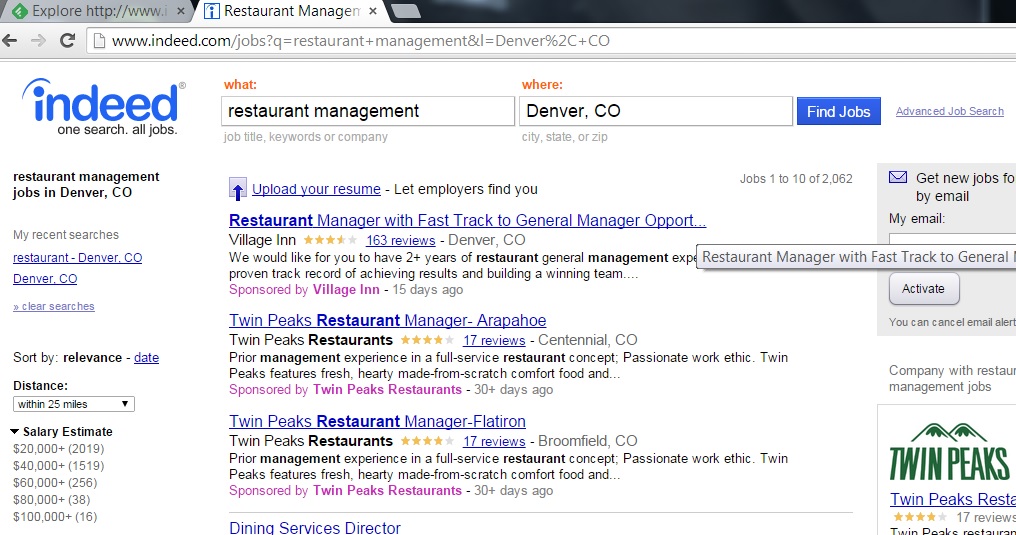
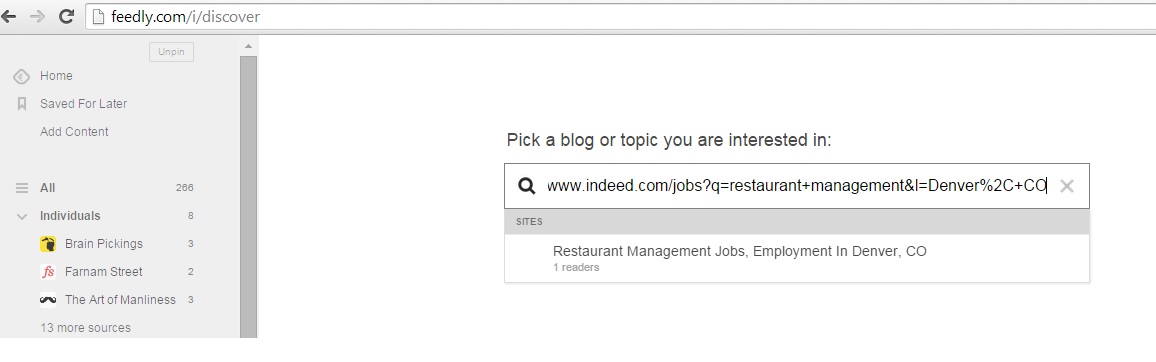

Viola! You’ll be managing a Twin Peaks in no time.
The advantage this provides is getting notified of new openings IMMEDIATELY. That way, you can be quicker than anyone else submitting your resume into the digital pile that gets ignored by hiring managers everywhere.
One last tip: Indeed has a ‘quick apply’ feature where you upload your resume and you can apply to certain jobs almost instantly. This eliminates the hassle of writing a stupid cover letter.
What are you waiting for? Get a job, you filthy animal!

 The Siding Spring