
Salvador Dalí, Tête Raphaëlesque éclatée [Exploding Raphaelesque Head], 1951
Take the e-tour at the National Gallery of Scotland’s website where the work resides and listen to Scottish people talk about the finer details:
Salvador Dalí, Tête Raphaëlesque éclatée [Exploding Raphaelesque Head], 1951
Take the e-tour at the National Gallery of Scotland’s website where the work resides and listen to Scottish people talk about the finer details:
“People think they don’t understand math, but it’s all about how you explain it to them. If you ask a drunkard what number is larger, 2/3 or 3/5, he won’t be able to tell you. But if you rephrase the question: what is better, 2 bottles of vodka for 3 people or 3 bottles of vodka for 5 people, he will tell you right away: 2 bottles for 3 people, of course.”
-Israel Gelfand
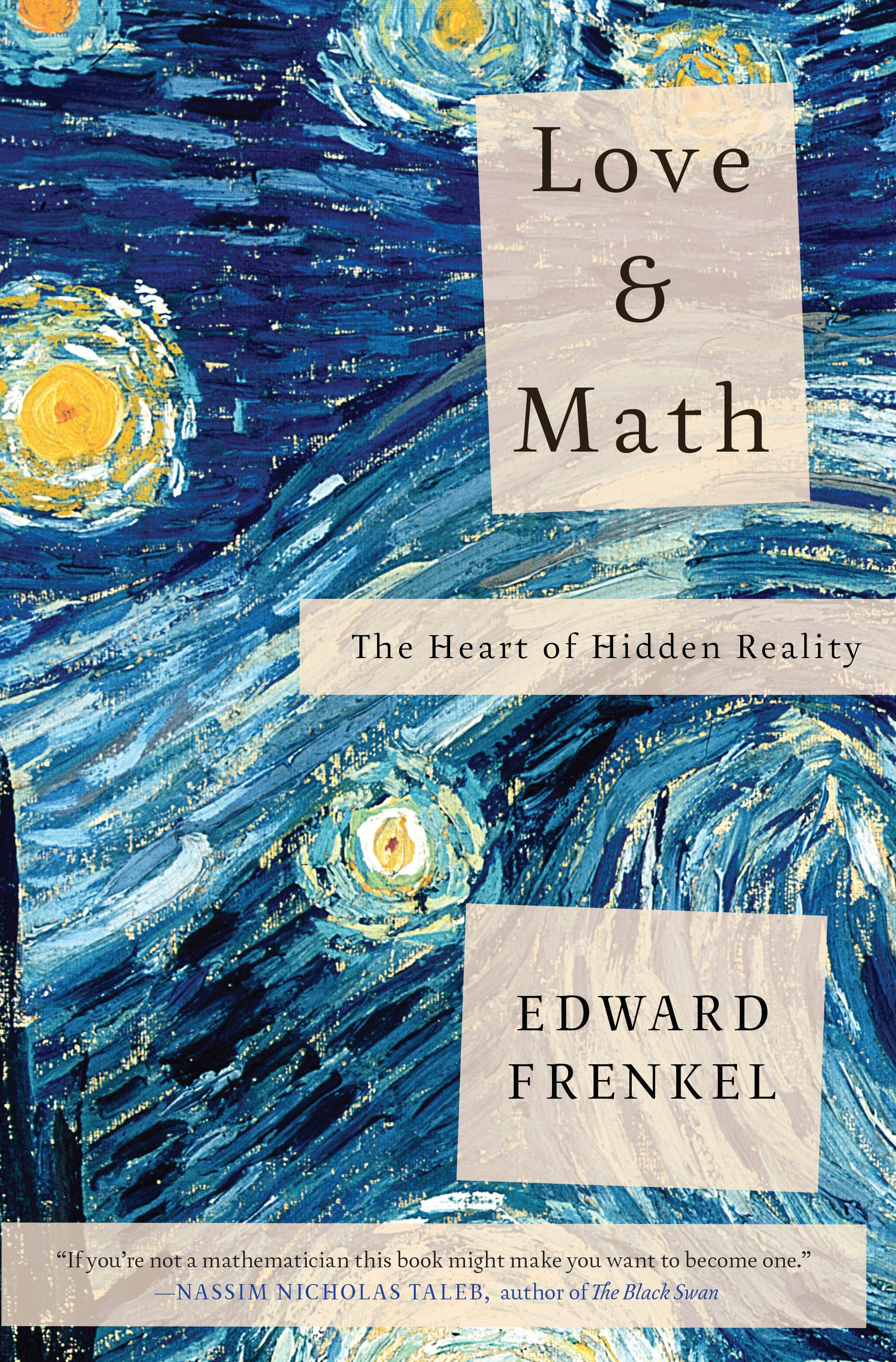
Edward Frenkel does a good job highlighting the pivotal importance of math. He asserts that instead of being a dull academic subject, it’s a universal language, free from bias, that can make apparent the deeper mysteries of the universe. If only it was taught different in schools.
Frenkel is a professor of mathematics at UC Berkeley. Even though he is under fifty, he has had a rich and distinguished career that traces back to the Soviet Union of the 1980’s, when Communist oppression was in full force. His story is my favorite part of this book, and his struggle just to get a decent education as a Jew facing blatant bureaucratic discrimination made me more appreciative of the freedoms I enjoy. indeed, this oppression was a source of strength for him, going on to say that, “In this environment, mathematics and theoretical physics were oases of freedom. Through communist apparatchiks wanted to control every aspect of life, these areas were just too abstract and difficult for them to understand.” Mathematics set him free, and his passion for the subject is infectious because he’s also a clear and thoughtful writer.
Further Links:
Slate piece by the author, illuminating the political importance of a mathematically literate society.
Farnam Street review, more in depth than my own.
What the professionals had to say: The New York Times review.
Buy from Amazon: Love and Math: The Heart of Hidden Reality

I find that there are few things more life affirming than walking through a cemetery on a gorgeous day. As your eyes pass over each headstone, names and dates tumble through your mind, drawing associations and thinking of questions for the dead.
Walking through the Olinger Crown Hill Cemetery on a clear spring day, I saw the tombstone Ulysses S. Grant who was born in the mid-1870s and died in 1919. You wonder how he felt being named after a war hero and president. Did he feel dignified? Was it annoying? Did he feel like Michael Bolton in Office Space?
Further back, walking off the trail, there’s an area for infants born a hundred years ago. Here lies James D. Norton, alive for three months in 1916. And others. Unsure whether to feel lucky to have survived infancy or slump my shoulders in grief, I took time to do both.
Off in the far corner, the military men are divided by wars they served in. Among the older graves stands a monument to the Spanish American War. What was that war even about? Did it even matter?
More importantly: was it worth it?
Moving on, I saw the tombstone of a 26-year old World War II veteran. He survived the war but not the 1950’s. You think about all the sagely WWII veterans who lived to old age and how admirable they all were. Why didn’t this one make it?
Among the we are forced to answer the question Leo Tolstoy (1828-1910) felt was central to life itself:
“My question, the one which brought me, at the age of fifty, to the verge of suicide, was the simplest of questions, the one that every man carries in the depths of himself, from the stupidest child to the wisest old man–the question without answering which life is impossible, as I indeed experienced. Here is that question: ‘What will come of what I do now, of what I will do tomorrow–what will come of my whole life?’ Formulated differently, the question would be the following: ‘Why should I live, why desire anything, why do anything?’ It can also be put like this: ‘Is there a meaning in my life that will not be annihilated by the death that inevitably awaits me?’“
We are built to confront this question, whether or not we are prepared to answer it. Any other secular place around town lacks the gravitas to pose these weighty questions to us. A higher meaning might be advertised in a department store but good luck actually finding it.

The point of this book is tough to describe. The author is so persuasive that he could probably convince me of anything, his examples are so wide ranging and his conclusions far fetched but airtight. One way Robert Wright states his hypothesis is that Francis Crick is wrongly credited with discovering the secret to life in DNA. John von Neumannn is a better candidate for that distinction with his discovery of game theory.
He posits that overall, human history has been trending toward greater cooperation and connectivity. As ideas and industry spread, more people become dependent on one another and their tribal circle expands, allowing even greater cooperation. This all sounds very utopian and rosy, and this book was written pre-9/11, but the more Wright expands his argument, the more you realize he isn’t crazy or stupid. If nothing else, this book is an incredibly persuasive example of revisionist history. I don’t mean that because it’s false, but it does make you rethink what you thought you knew. My favorite digression is the part about barbarians, “we were all once barbarians”.
Further Links:
Robert Wright’s TED Talk on non-zero-sumness: He’s certainly a better writer than public speaker.
The Nerdist Podcast with Jon Favreau: Good throughout, at around 1:06 Favreau has a thought that elucidates the theme of this book very well. I wonder if he’s read it.
This book is on Bill Clinton’s list of favorite books. Lists of imminent people’s favorite books are always interesting, here’s Teddy Roosevelt’s.
Buy on Amazon: Nonzero: The Logic of Human Destiny
Stuff of Interest:
teleological—an attempt to describe why something happened, instead of simply noting its existence.
Lewis Henry Morgan, John Stuart Mill, and Margaret Mead: notable people with differing views of the directionality of history (does it follow a path or not?).
Hobson’s Choice— ‘Take it of leave it’ a choice in which only one option is offered.
Jericho—The history of this city is incredible. I thought it was a Biblical myth but is in fact real as Cincinnati (another place I’ve never been).
Continue reading

“Man naturally desires not only to be loved, but to be lovely.”
—Adam Smith
Russ Roberts is an academic economist best known as the host of the EconTalk podcast, wherein he interviews people knowledgeable in public policy and economics. This book is his exploration of what Adam Smith had to say about living a good life. Roberts thinks it’s a shame that Smith is thought of as an economist before a moral philosopher, and seeks to remind readers through this book of the power of Smith’s moral wisdom. He focuses primarily on Smith’s book The Theory of Moral Sentiments rather than the work Smith is best known for, The Wealth of Nations, which unfortunately is commonly used to legitimize the power of venal self-interest.
How Adam Smith Could Change Your Life explores the idea of acting like you have someone, some ‘indifferent spectator’, judging your actions. Something like a conscience. The importance of introspection is also examined, along with some reasons why self-knowledge is so difficult, the corrosive pitfalls of seeking out fame, how empathy with someone is easier in good times than in bad, and how tempting but dangerous it is to make exceptions in some circumstances. “Smith admits there can be some extenuating circumstances that make the rules of justice more flexible. But he suggests that such an approach to justice is a very slippery slope. He urges us to follow the rules of justice with complete steadfastness; the more we do so, the more commendable and dependable we are.
I also enjoyed P.J. O’Rourke’s On The Wealth of Nations: Books That Changed the World
Further Links:
School of Life’s video profile on Adam Smith, along with his write-up in The Philosopher’s Mail.
Part 1 of a 6 part series of interviews with Dan Klein that inspired the book.
What the professionals had to say: The Wall Street Journal book review.
Buy from Amazon: How Adam Smith Can Change Your Life: An Unexpected Guide to Human Nature and Happiness
“The Internet’s Own Boy: The Story of Aaron Swartz”—a fantastic documentary, via Farnam Street. To add to this discussion I would also consider the New Yorker’s profile on Aaron Schwartz, ‘Requiem for a Dream’.
“This is the story of a boy my age who tried to make his expectations of the world become reality. Instead, he was crushed by the very system he sought to change. I don’t necessarily agree with his views but his story is as incredible as it is inspiring. “HE WAS NOT a saint. He could be as petty as anyone. But the thing that makes a good life isn’t constantly being saintly—it’s just continuing to do shit. We spend so much time waiting to start to live. He always went big—he never looked for permission to go big. He assumed that he could talk to anyone he wanted, and he was right, and it wasn’t because he was super-special-genius-boy, it was because he tried.” “WE WERE TALKING about the money and about how much debt it was reasonable for him to go into around the case. I was saying, ‘You can get a half-million salary a year as a C.T.O. for some tech company.’ And he said, ‘I would rather sleep on friends’ couches for the rest of my life than take a job I don’t want.'”
I’ve also taken a few book recommendations from his annual Review of Books, most notably Moral Mazes: The World of Corporate Managers
I find his work surreal and morbid without being gloomy.
But really, what is there to say about art except whether you like it or not? I can’t say why I like his paintings, I just do–check them out at the James Ensor Online Museum.

James Ensor, The Intrigue, 1890
From Reuters, a reminder that pragmatic decisiveness is an important characteristic of leadership:
“So how did Putin and Netanyahu wind up with enough admirers in this country to place them on the list? The simple answer may be that they exude certitude in an age that reveres it, and views it as strength.
This is the opposite of what we are taught in sophisticated college humanities courses — that certainty is the dominion of fools and knaves. There is no absolute truth, scholars insist, and even if there were, no one could claim a monopoly on it. We are taught to believe in ambiguity, accommodation and a certain kind of intellectual modesty — that just because we may feel something doesn’t make it true or right. This sort of modesty is regularly cited as one hallmark of great thinkers and great people. They understand their limitations.
But in the real world, people do not necessarily find intellectual modesty admirable. What the hurly-burly of life seems to teach is that the one thing we can admire is a person’s sense of certitude — honoring deep conviction and an unwillingness to countenance doubt.”
My new job came with a long commute and so lately I’ve had an abundance of time to spend listening to podcasts. What follows are seven of my favorites along with the five episodes I’ve found most engaging. Enjoy:
The Joe Rogan Experience Comedian Joe Rogan is a master conversationalist. He interviews a wide swath of people, from famous entertainers and scientists to professional athletes and snake oil charlatans.
Here’s The Thing Alec Baldwin needs no introduction. His podcast shines because he’s a celebrity interviewing celebrities so to they open up to him in a way they are hesitant to around journalists.
WTF with Marc Maron Marc Maron is a nutjob, and his neurotic rants about his three cats can get irritating, but he isn’t scared to get into deep emotional issues with his guests.
The Nerdist I was a latecomer to this podcast but a coworker convinced me I’ve been missing out. Chris Hardwick and his crew pretend they’re nerds but I don’t really buy it. Their interviews are thoughtful and everyone involved is articulate and well-rounded.
Econtalk Econtalk is hosted by Russ Roberts, a noted economist and author. His guests are the most intellectual and wonky of the podcasts I’m recommending, but Russ always manages to get enlightening conversations out of them.
The James Altucher Show James Altucher interviews on independent-minded artists and businesspeople and does a good job at finding out how they operate. WARNING: the intro theme is atrocious and he does NOT have a radio-friendly voice.
The Dr. Drew Podcast Dr. Drew from Loveline has a podcast of his own dedicated to interviewing other medical professionals and notable people he finds interesting. He is a great interviewer and conversationalist with 30 years experience in traditional radio. The man is superhuman but the series of shows concerning his recent recovery from prostate cancer is humanizing (SEE: episodes 138-141).
The Tim Ferris Show Tim Ferris is an amateur at podcasting and his personality can be a bit grating because he talks too much and he reuses a lot of questions from guest to guest, but the people he talks to are so interesting that his shortcomings as a host are easy to overlook.
Long form interviews are the anecdote to a tedious commute. Just be sure to fast forward past the scammy start-up advertising that makes these shows financially viable. Also check out Hardcore History and The Adam and Dr. Drew Show, both of which are consistently entertaining.

Check ignition and may God’s love be with you
From Wired:
“The David Bowie song “Space Oddity” probably shouldn’t have been made into a children’s book: The haunting 1969 track about an astronaut who loses contact with Earth to float around the universe would probably give most kids nightmares.
That didn’t stop illustrator Andrew Kolb from turning the space-rock song into an illustrated book. As seen in the gallery above, the artist lays down Bowie’s hit about a spaceman in a ‘tin can’ line by line.”
Andrew Kolb’s impressive portfolio can be seen HERE.


 The Siding Spring